
Skip to Main Content

Research Data Management

What is Open Code?

Open Code refers to custom, author-generated code used in a scientific research study — often during data collection, interpretation or analysis—and subsequently made publicly available under an Open Access license via a linked repository, or as Supporting Information.

Reference: Public Library of Science (PLOS). Open Code

UNESCO's Recommendations

The UNESCO Recommendation on Open Science advises that open-source software and source code should be made publicly available in a timely, user-friendly, modifiable format under an open licence that allows others to use, study, modify, create derivatives, and share it. The source code must be included in the release, deposited in openly accessible repositories, and licensed under terms that permit modification and redistribution. In open science, when software is part of the research process, reuse and replication generally require that the code be shared together with open data and clear specifications of the environment needed to compile and run it.

Reasons for Open Code

Reasons for researchers opening up their source code or reusing the Open Code of others include:
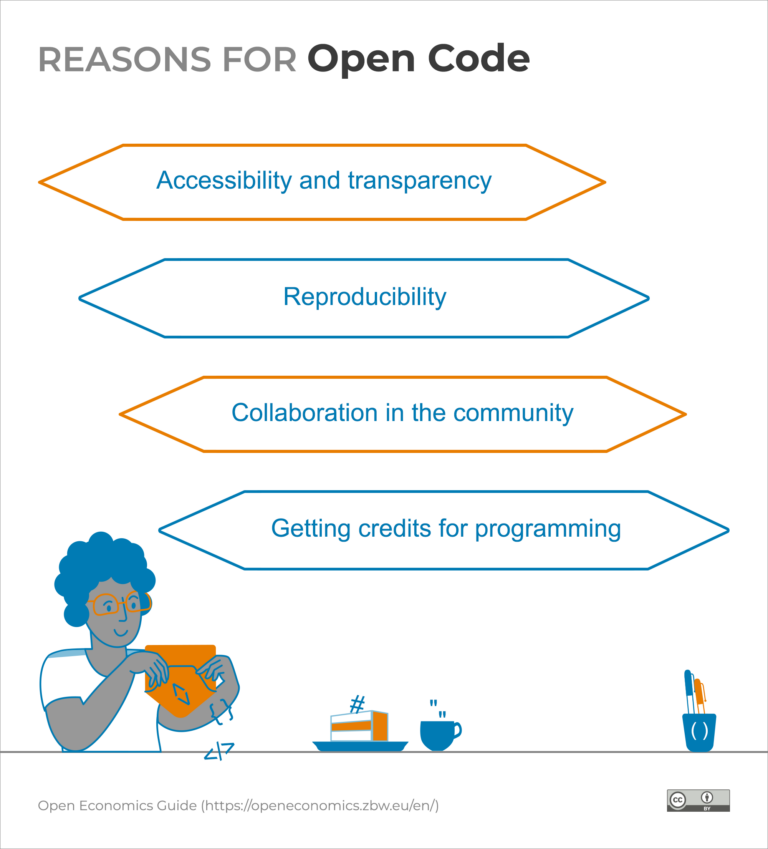
  1. Accessibility and transparency: Open Code is easily accessible and provides a high degree of transparency. It makes it possible to understand and review the processes and results of other researchers. 
  2. Reproducibility: Open Code supports the reproducibility of research work. It enables others to examine, verify, and build on previous research results. This strengthens credibility and trust in research work.
  3. Collaboration in the community: Open Code promotes knowledge sharing, troubleshooting, and innovation and opens up perspectives for new research directions. By sharing code openly, others can actively contribute to the code, give feedback, build their work on it, and thus avoid duplication of effort.
  4. Getting credits for programming: Programmers receive recognition for their programming work.

Source: Open Economics Guide by ZBW

Open Code Checklist

You may like to refer to this checklist when making your code open:

  • If you have written code, have you documented your test protocol?
  • Have you scripted your analysis, including data cleaning and wrangling, where applicable?
  • Is your code well annotated and documented for ease of understanding and reuse?
  • Has the use of all software versions and computing environments been documented where applicable?
  • Are you able to openly share your code?
  • If you have shared your code, have you shared it under an open license?
  • Have you adopted the FAIR principles for research software?
  • Did you know that you can anonymise your GitHub repository when sharing your code with blind peer reviewers?

How FAIR is your Research Software aand Code?

Check out the following tools:

  • Use the 'Self-assessment for FAIR research software' Checklist by Netherlands eScience Center and Australian Research Data Commons to assess your software’s FAIRness and receive a badge:

FAIR checklist badge

Making your Research Software and Code Citable

Making your software citable both gains credit for your work, and improves reproducibility of research that relies on the software. There are a variety of ways to make your software citable:

  • Publishing your software in a software journal provides a citation with a persistent identifier, and provides peer review.
  • Publishing your software in a major general replication archive provides a citation with a persistent identifier, and usually allows you to publish citable new versions of the software as you choose. Contact DR-NTU (Data) for guidance.
  • If you publish software in Github, you can create a citable archived version whenever you choose, through Zenodo.

Open Code Resources

Health Data Research UK: Open Science Open Code

Health Data Research UK believes that open code fosters transparency and increases reuse and collaboration. Visit their GitHub where they have curated over 150 repositories of open standards, data and source code.